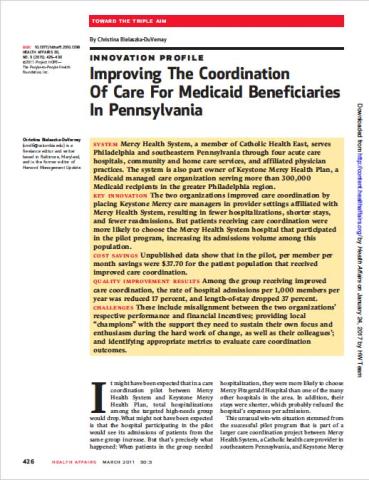
System: Mercy Health System, a member of Catholic Health East, serves Philadelphia and southeastern Pennsylvania through four acute care hospitals, community and home care services, and affiliated physician practices. The system is also part owner of Keystone Mercy Health Plan, a Medicaid managed care organization serving more than 300,000 Medicaid recipients in the greater Philadelphia region.
Key Innovation: The two organizations improved care coordination by placing Keystone Mercy care managers in provider settings affiliated with Mercy Health System, resulting in fewer hospitalizations, shorter stays, and fewer readmissions. But patients receiving care coordination were more likely to choose the Mercy Health System hospital that participated in the pilot program, increasing its admissions volume among this population.
Cost Savings: Unpublished data show that in the pilot, per member per month savings were $37.70 for the patient population that received improved care coordination.
Quality Improvement Results: Among the group receiving improved care coordination, the rate of hospital admissions per 1,000 members per year was reduced 17 percent, and length-of-stay dropped 37 percent.
Challenges: These include misalignment between the two organizations’ respective performance and financial incentives; providing local “champions” with the support they need to sustain their own focus and enthusiasm during the hard work of change, as well as their colleagues’; and identifying appropriate metrics to evaluate care coordination outcomes.
Note: This paper was commissioned by Health Affairs and is based partly on a presentation by Grace Lefever, Mercy Health System, and Karen Michael, Keystone Mercy Health Plan, that was delivered at a Health Affairs conference, Innovations across the Nation in Health Care Delivery, December 16, 2010, in Washington, D.C.
 University of San Francisco California